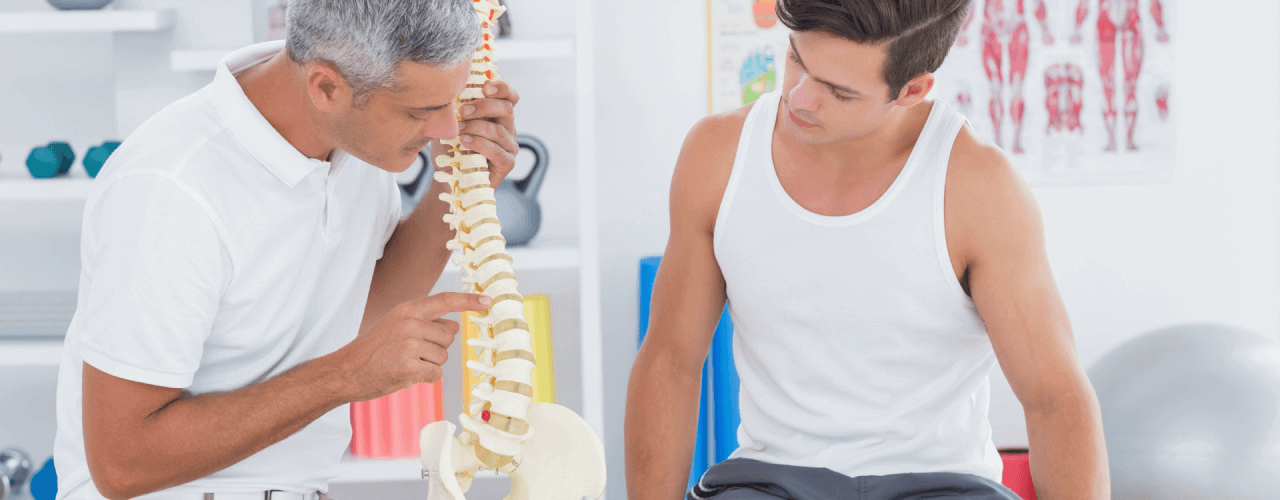
Has your back pain been making everyday tasks feel impossible? Is it a struggle to simply get through the day? If you have been negatively impacted by back pain, know that physical therapy can help to provide answers– and solutions.
One possibility is that you have a herniated disc. This can put extra pressure on the muscles and nerves that surround the spinal column. If you are experiencing pain on one side of the body, pain that radiates to the arms or legs, aching, burning sensations in the affected area, and pain with certain movements, talk to your doctor about how physical therapy may benefit you.
Albanese Physical Therapy in New Brighton, PA has the tools and the talented staff to help you make your back pain a thing of the past.
What causes a herniated disc?
Your spinal discs are squat discs of tissue that lie between the vertebrae. A disc consists of a fluid-filled center called the nucleus pulposus encased in an outer structure called the annulus fibrosus. This arrangement makes the disc both tough enough and spongy enough to absorb shocks.
Unfortunately, that toughness has its limits. Sometimes a disc will lose hydration over time, causing the nucleus pulposus to shrink. The disc loses its height, which stresses the spinal joints and may cause the disc to bulge outward. A herniated disc is what occurs when a spinal disc protrudes through the outer ring. This leads to numbness, pain, and discomfort.
A number of factors can cause a herniated disc. Herniated discs can occur suddenly due to an auto accident, workplace accident, or sports injury that traumatizes the spine. Certain motions, like turning, twisting, or lifting heavy objects can also cause a herniated disc.
Overweight and elderly people are at a higher risk for developing a herniated disc. This is because strain is more likely when spinal discs have to support more weight. And as we age, our discs begin to lose some of their protective water content, which causes discs to slip more easily out of place.
Interestingly enough, not all herniated discs will lead to pain (especially because the discs themselves are relatively low in innervation and vascularization). However, when a herniated disc does cause symptoms, these symptoms often include:
- Pain that worsens with forward flexion or prolonged sitting—forward flexion may also cause the pain to “peripheralized” or move further away from the spine
- Arm or leg pain, numbness, tingling, and weakness (if the herniated disc
- compresses on an adjacent nerve root that innervates the affected limb)
- Pain that improves or “centralizes” (moves toward the spine) with spinal extension, such as when lying down or lying prone
- Neck or back pain, stiffness, and muscle spasms at the level of the injured disc
How does physical therapy help?
Physical therapy is an essential component of the recovery process from a herniated disc. If your symptoms are interfering with your daily activities or at work, or if they last longer than two weeks, we recommend seeing a physical therapist.
Your physical therapist will implement a variety of different techniques for pain relief and healing. Deep tissue massage, electromagnetic stimulation, and heat and cold therapies are just a few of the passive treatments available to you.
Deep tissue massage applies pressure to ease spasms and deep muscular tension caused by a herniated disc. Heat therapy promotes healing by increasing blood flow to the damaged area, while inflammation is targeted and reduced in cold therapy. Electric nerve stimulation works by sending small electric currents along the nerve pathway to limit pain receptors and reduce muscle spasm.
A physical therapist’s active treatments focus on joint movement, stability, flexibility, strength, and posture. To strengthen the back muscles, a physical therapist will teach you core stabilizing exercises. You’ll also strengthen and condition your body by performing a variety of exercise movements. In addition, a physical therapist will teach you proper stretching and flexibility exercises.
Don’t wait, contact Albanese Physical Therapy in New Brighton, PA today!
If your back pain is slowing you down, turn to physical therapy for help. To establish if you have a herniated disc, a physical therapist will perform a thorough examination and analyze your medical history.
A physical therapist will create and administer a treatment plan tailored to you that targets your pain head on. At Albanese Physical Therapy, our goal is to help you live a more active and pain-free life. Let us help you get back on your feet after a herniated disc.